
What's the Point?
Meeting Sonia Sotomayor, making a case against nihilism, and talking about a writing course

Oh hey, hello. How’s your fall?
I’ve always liked this time of year, the start of the school season. (I’ve always been a nerd.) And growing up in Hawaii, where the weather barely changed, fall was always my favorite fantasy. I would imagine myself in leather boots, crunching yellow leaves, coffee cup in hand.
Now, living in the PNW, it doesn’t disappoint. (I like the rain.)
I hope you’re finding joy these days.
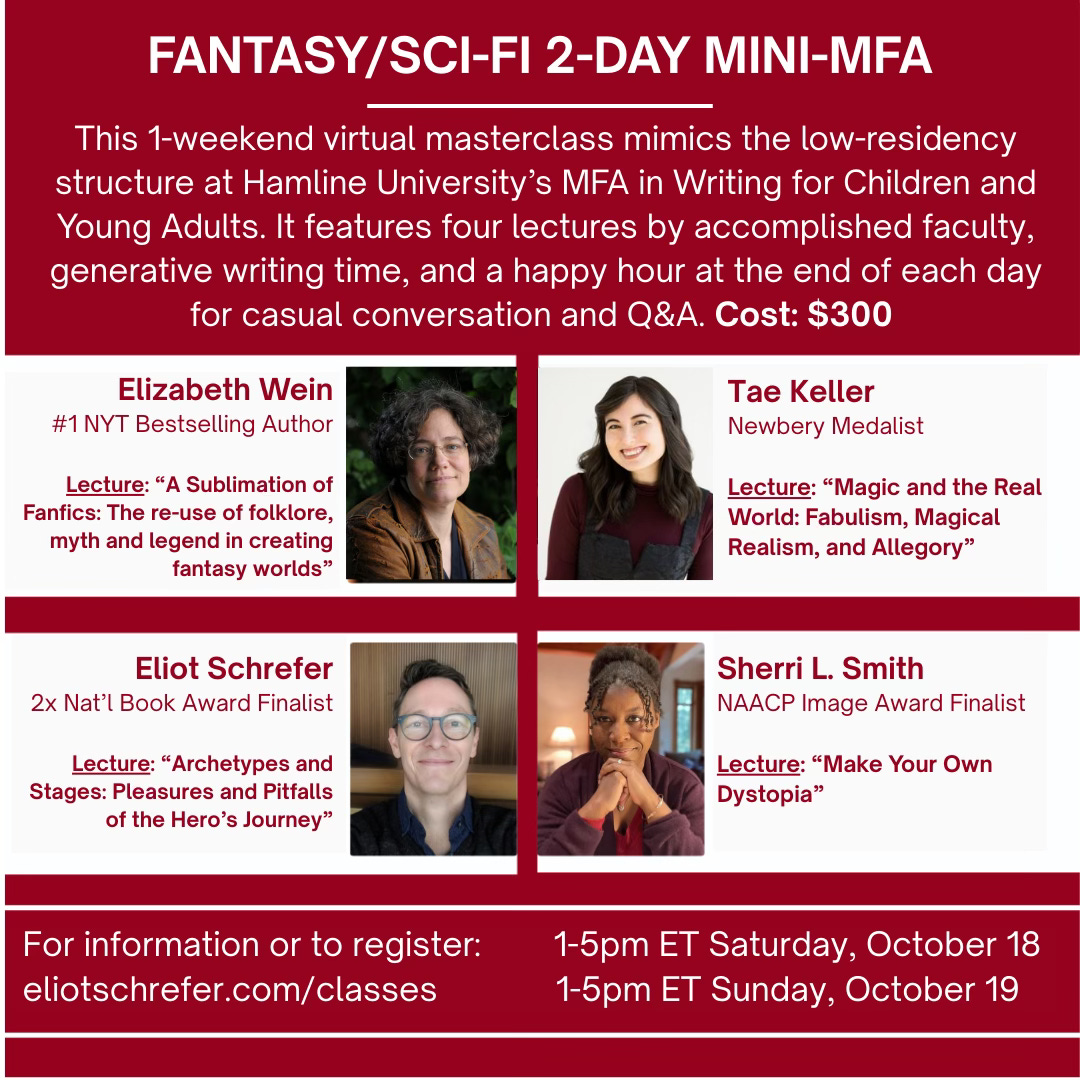
Before I start talking about, you know, the state of the world*, I want to announce that I’ll be teaching a mini writing course next month. A few of my colleagues in the Hamline MFA program and I are each doing a lecture, followed by writing prompts and Q&As.**
We’ll be focusing on writing sci-fi and fantasy for children, and I’ll be talking specifically about writing magical realism and allegory. Teaching has been one of the most rewarding things I’ve done in my writing career, and I’ve loved learning from my colleagues and with my students.
If this sounds interesting or exciting to you, I hope you join us. ❤️
*I suppose this is slightly misleading, since my lecture will be about using sci-fi and fantasy to address the current state of the world.
**The lectures and Q&As will also be recorded for attendees, so you can watch all of them even if you aren’t available all weekend.
What’s the Point?
Or, the case against nihilism
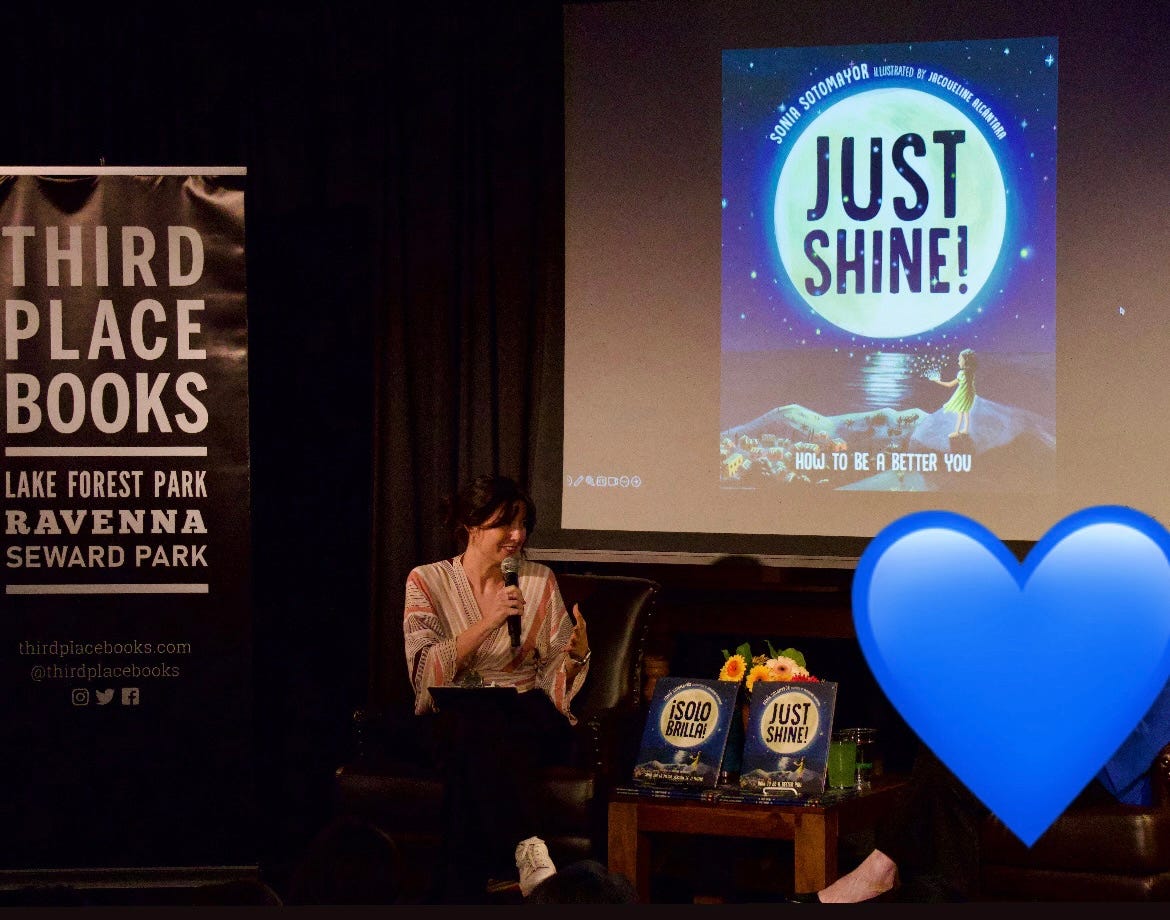
Two weeks ago, I had a major is this my life career moment. I interviewed Sonia Sotomayor at my local bookstore, in front of 700 people.
We spoke about family, fantasy novels, justice, and hope. She got up in the middle of the event to hug every child in the audience, and the night was full of warmth.
This event came just days after the Supreme Court’s devastating decision, where they ruled that ICE can arrest people just for a) looking Latino, b) speaking Spanish or accented English, and c) working a low-wage job.
Sotomayor, of course, wrote a passionate dissent (which you can read!), and I’m so grateful that I got to thank her for it in person, in a room full of 700 other passionate people.
Unfortunately, Sotomayor is not in the majority. The decision will harm thousands. It will set a dangerous precedent. And now, just two weeks later, this crucial decision is already buried in the news.
**
In the past two weeks:
A popular podcaster was assassinated at a public event. JD Vance and Stephen Miller called for vengeance against liberals and the left. Jimmy Kimmel got cancelled. Jimmy Kimmel got uncanceled. Israel continued to kill Gazans seeking aid. The US sent warships to Venezuela and seized what appears to be a fishing boat. RFK Jr decided he hates Tylenol. Trump directed the FBI to target people with anti-capitalist or anti-Christian beliefs. The rapture didn’t happen.
Billy Joel could write a “We Didn’t Start the Fire” redux on these fourteen days alone.
How is a normal person supposed to respond to any of this?
What are we supposed to focus on? How are we supposed to feel anything except anger, and then despair?
**
Anger is a powerful feeling, and there’s certainly a lot to be angry about. I’m angry, too.
It doesn’t make sense to dismiss anger entirely. But . . . anger is unsustainable. It runs on adrenaline, and the human body can’t hold it forever, at least not in its energetic form. And when it burns out, only despair is left—the ash that anger leaves behind.
Unlike anger, despair is quiet. It creeps up, tendrils of dread, a fist around the heart dragging down and down.
I’ve felt it at points, if I’m being honest. My friends, too. Even some kids confess the feeling to me, the kind of exhausted nihilism that masquerades as logic. The kind that whispers in your ear, What’s the point of trying?
That’s the key, I think, the question we need to answer. What’s the point?
**
Who a story is about dictates what a story is about.
The stories we see in the media and on our algorithms focus on Trump and his administration, horror after horror. And while it’s important to keep informed, that’s not the only reason these stories tend to focus on Trump. It sells, of course, to keep us doomscrolling. To keep us angry.
And I’m tired, I’m so tired of Trump being the main character. Any story about him focuses on cruelty rather than humanity. How much cruelty can the heart consume before collapsing?
Because love, joy, each other—that should be the point, right? It has to be.
I think often of last year’s protests in Korea.
They were fighting against an authoritarian takeover. The stakes were high, and certainly Koreans knew that; their history runs deep with scars.
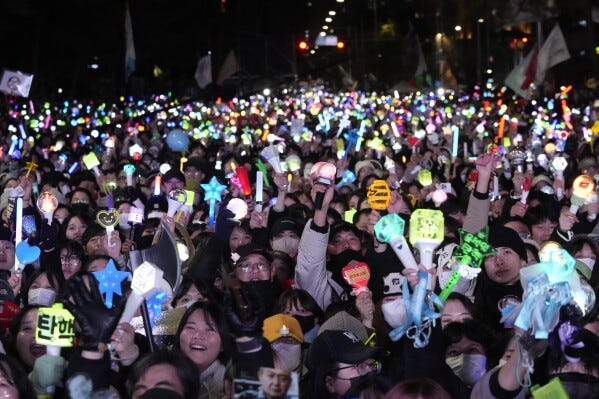
But they turned their protest into a movement of willful, determined, collective joy. They blasted K-Pop and handed out glowsticks. They danced together and sang together. They became the center of their story, rather than their president.
And I don’t know what it was like to be there, but seeing it from the outside felt like: this—this joy, this freedom, this togetherness—this is worth fighting for.
**
I know, I know, how cliché of me, a children’s book author advocating for love over hate.
But I don’t say this as a squishy platitude. I say this as a means of survival.
We have to tell ourselves a different story. Instead of centering the people doing harm, we can center the people being harmed—not merely as victims, but as people.
It sounds obvious, but it took me a while to understand this. And while I certainly believe that books are important here—my own worldview has changed significantly thanks to both fiction and nonfiction—I’m not sure books can do this work alone.
A personal example, then: When I moved to Seattle in 2020, the problem of homelessness and affordable housing became impossible to ignore. Walking through my new city, I couldn’t avoid the suffering.
In response, I did what I always do. I read about it, trying to understand. I learned about how the housing crisis, medical debt, and the prison system intersect to perpetuate suffering. I learned about how other developed countries, even the most expensive ones, have protected their citizens with social safety nets. I learned that roughly half of homeless people in the US have a job and still can’t afford a place to live.
And I became so angry, rightfully, at the way our politicians did nothing to actually address the problem. Rather than building housing, they chose instead to sweep people from street to street, treating human beings like trash.
Learning about the systems of oppression—and seeing the way real estate developers and huge corporations like Amazon and Microsoft poured money into maintaining these systems—made the problems feel insurmountable.
Cue despair. There was nothing I could do to fix all of this. What’s the point?
But despair compounds. I was reaching a breaking point, and I couldn’t keep walking through my city, seeing people in need and doing nothing, feeling callouses build around my heart.
So, I signed up to volunteer with an organization that delivered supplies to homeless encampments—tarps, sleeping bags, food, gloves, hot coffee—despite it feeling like a band-aid on a gaping wound.
The first couple times I went, I was too afraid to really interact with anyone. That feels embarrassing to admit now, but if you’ve seen the news you probably understand. The unhoused population is portrayed as dangerous and destructive, unpredictable at best, monstrous at worst. Unhuman.
I’d thought, in all my reading about systemic problems, that I’d unpacked these biases, but they ran deeper than I’d imagined. It took a few months to untangle appropriate caution from internalized othering fear. But in time I did, and I realized how limiting and dehumanizing the stories we hear really are.
Any activist will tell you that many Americans are just a couple paychecks away from being homeless themselves. The people on the street, really, are just our neighbors, just us. I’ve come to think that this othering fear functions to mask a real, deeper fear: that this is true.
Because it is.
I get volunteering, and I got to know people. I heard their stories, often tragic but occasionally funny or triumphant. I played with their dogs. I saw the way a hot cup of coffee or cocoa makes anyone’s morning better.
And in all this, I realized, first: that it’s never pointless to care. Even if I’m not changing an entire system of oppression on a Saturday morning, making someone’s day a little bit better is always worth it.
And second: meeting people, hearing their stories, learning to care and empathize in a way I hadn’t before was energizing. I’m still angry, of course. And the broader systemic knowledge is useful for knowing where to direct that anger, for imagining a longer-term strategy.
But shifting my focus to the people I was helping made the calculus very simple: the work is worth doing. Even when it feels small, it’s worth it. Even when it feels hard, it’s worth continuing. And in fact, doing the work often feels good. Humans are built to help each other. It’s sustainable.
So volunteer, I guess, is what I’m saying. For whatever moves you. You probably don’t need me to say that.
But it helps.
**
Before I interviewed Justice Sotomayor, I read the full Supreme Court ICE decision.
Her dissent was far better reasoned than Kavanaugh’s majority opinion. Of course. But what struck me most was that she’d included the stories of the people affected. She wrote about US citizen Jason Gavidia, whom ICE shoved against a gate before they stole his REAL ID. And Jorge Viramontes, who was also assaulted and detained. She included the fears and experiences of other laborers, too, and wrote about the families affected.
Kavanaugh’s writing came off cold in comparison, like he hadn’t considered other people at all.
When I noted the difference to Justice Sotomayor, she told me her writing had changed over the years—that she’d learned how important it was to highlight the human connection at the heart of her work. Other humans are, after all, the whole reason for the work.
That’s it, isn’t it? That’s the point.
**
What about you? What are you doing? How are you feeling? Let me know—
With care,
Tae
Since Trump's first term, when I was feeling the despair you describe, I've been volunteering via Zoom with an organization called Seeds of Literacy. Tutors like me help some students work toward their GED and others simply enhance the quality of their lives by learning to read better and enjoy it more. The program is based in Ohio but you can tutor from anywhere! www.seedsofliteracy.org/
After the 2016 presidential election I vowed never to sit in front of my TV and watch returns. So I decided instead to volunteer as a poll worker. I have since worked the polls for every election. It is an unusually long day (6a-10p) but I get out of it much more than I give (which is almost universally the case with volunteering). I leave energized, hopeful, more open to meeting strangers, humbled by the lives of neighbors I'd never met, reminded that being an active part of my community makes me a better person.